
Unfolding: The Iterative Paths of Civilization
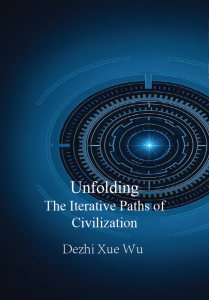 Every civilization believes it stands at the height of its own achievement. Yet history suggests a different pattern: civilizations do not reach a final destination—they unfold. Each age carries within itself the conditions that give rise to the next, reshaping how human beings understand work, power, knowledge, and ultimately themselves.
Unfolding: The Iterative Paths of Civilization explores this continuing process of transformation at a moment when humanity is entering one of the most profound transitions in its history. Artificial intelligence, automation, renewable energy, advanced computation, and intelligent machines are not presented as isolated technological breakthroughs, but as signs of a broader civilizational shift. The book asks a deeper question: what becomes of humanity when intelligence, productivity, and decision-making are no longer uniquely human?
Drawing on philosophy, history, systems thinking, economics, political analysis, and dialogues with artificial intelligence, Dezhi Xue Wu examines how every technological revolution reorganizes civilization itself. As industrial society gives way to an era increasingly shaped by physical AI and autonomous systems, traditional assumptions about labor, wealth, sovereignty, education, and even human identity begin to change. The central challenge is therefore not technological, but civilizational.
Rather than offering predictions about the future, the book explores the enduring patterns through which civilizations emerge, mature, fragment, and reorganize. It considers questions that will define the coming century. What gives meaning to human life when work is no longer its primary organizing principle? How will nations exercise power when computation, energy, and intelligent systems become the foundations of strategic influence? Can societies lose their place in history not through military conquest, but by becoming disconnected from the technological networks upon which civilization increasingly depends?
Throughout the book, technology is understood not as an external force, but as an extension of human consciousness. Every new tool transforms not only what people can do, but also how they perceive the world, organize society, and define themselves. The emergence of artificial intelligence therefore represents more than a technological revolution; it marks a new stage in the long unfolding of civilization itself.
Neither optimistic nor dystopian, Unfolding offers a philosophical exploration of humanity’s future in an age of accelerating change. It argues that the greatest questions of the twenty-first century are not simply about machines, but about civilization, meaning, and the enduring place of human consciousness within an increasingly intelligent world. Rather than predicting what the future will look like, the book seeks to understand the deeper patterns through which every future comes into being.